

The Strait of Hormuz, a narrow waterway between the Persian Gulf and the Gulf of Oman, serves as one of the world’s most critical chokepoints for global oil transportation. Approximately one-fifth of the world’s petroleum passes through this strategic corridor daily, making it vital to energy markets and international trade. Amid the Iran-Israel war, Iran has planned to close the Strait, which could have profound implications, not only for oil-exporting nations in the Middle East but also for global energy security, economic stability, and international trade flows. Export Genius explains what is Strait of Hormuz is and how its closure could impact global trade.
What Is the Strait of Hormuz?
The Strait of Hormuz is a narrow but critically important waterway located between the Persian Gulf and the Gulf of Oman, connecting major oil-producing countries (like Saudi Arabia, Iraq, the UAE, and Iran) to global markets.


- Location: Between Iran (north) and Oman & the UAE (south).
- Width: As narrow as 21 miles at its tightest point.
- Importance: It is the world’s most important oil transit chokepoint.
Why Is It Important?
- Roughly 20% of the global oil supply passes through this strait daily — that’s about 15–17 million barrels per day
- It also carries liquefied natural gas (LNG) exports, especially from Qatar (the world’s top LNG exporter)
- Almost all of the Gulf’s oil exports must go through this narrow passage — there’s no real alternative for large-volume seaborne exports
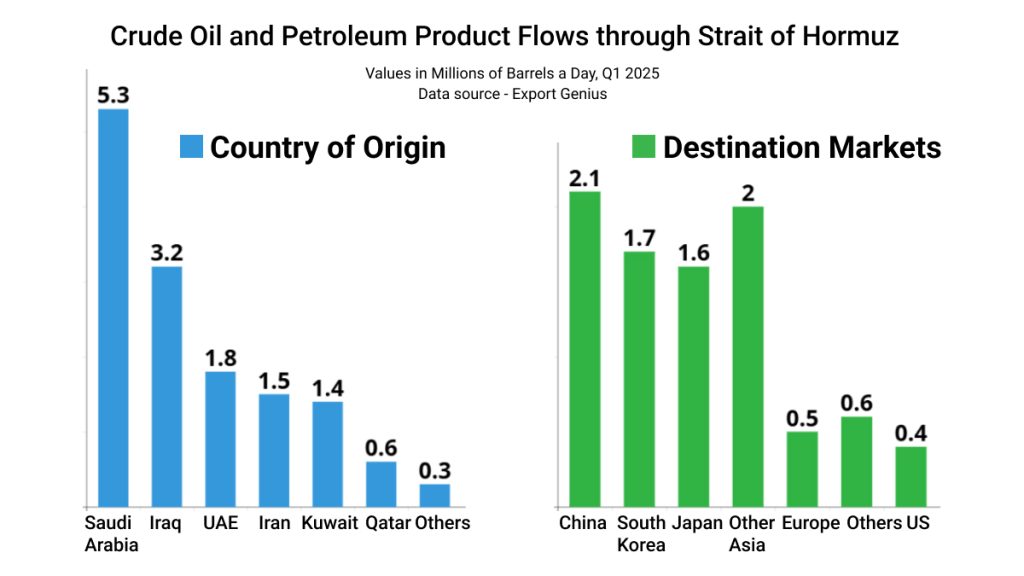
| Country of Origin | Export Value | Destination Markets | Import Value |
| Saudi Arabia | 5.3 | China | 2.1 |
| Iraq | 3.2 | South Korea | 1.7 |
| UAE | 1.8 | Japan | 1.6 |
| Iran | 1.5 | Other Asia | 2.0 |
| Kuwait | 1.4 | Europe | 0.5 |
| Qatar | 0.6 | Others | 0.6 |
| Others | 0.3 | US | 0.4 |
*****Values in Millions of Barrels a Day, Q1 2025
How Would a Closure of the Strait of Hormuz Affect Global Trade?
If the Strait of Hormuz were closed or blocked (due to military conflict, sanctions, or sabotage), the impact on global trade would be massive and immediate:
1. Oil Prices Would Spike
- Disruption in supply would trigger a global oil price surge.
- Could push oil over $150–200 per barrel depending on the duration.
- Immediate shock to energy markets, inflation, and transportation costs.
2. Energy-Importing Countries Hit Hard
Nations like India, China, Japan, South Korea, and many in Europe are heavily dependent on Gulf oil and LNG.
Their fuel costs would soar, affecting industry, logistics, and household energy.
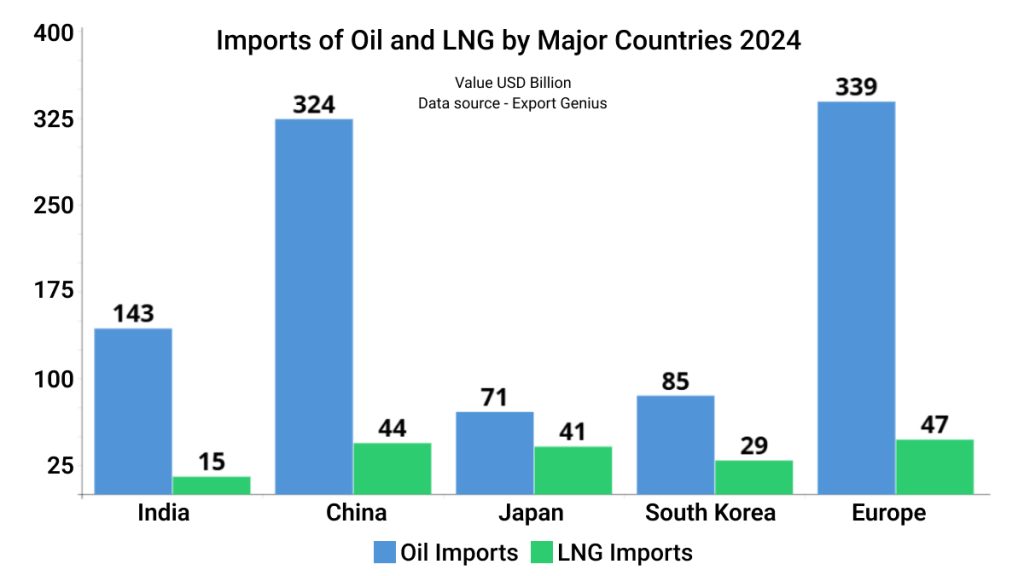
| Importing Countries | Oil Imports | LNG Imports |
| India | 143 | 15 |
| China | 324 | 44 |
| Japan | 71 | 41 |
| South Korea | 85 | 29 |
| Europe | 339 | 47 |
*****Value USD Billion
3. Shipping & Insurance Costs Increase
- Maritime shipping routes would be rerouted or delayed.
- Insurance premiums on vessels transiting the region would skyrocket.
4. Global Supply Chain Disruptions
- Any oil-dependent industry (plastics, chemicals, aviation, shipping) would face increased costs and delays.
- Countries with strategic oil reserves (like the U.S. and China) would start using them, but reserves are limited and short-term.
5. Geopolitical Instability
- Increased military presence in the region (U.S., UK, NATO forces).
- Risk of escalation into broader conflict involving Iran and neighboring Gulf states.
How will the Closure of the Strait of Hormuz Impact India?
- India imports 5.5 million barrels per day (bpd) of crude oil, with 2 million bpd passing through this strategic waterway. However, experts believe that India’s position will remain secure due to its diversified import strategy, with alternative suppliers including Russia, the United States, and Brazil available to maintain supply continuity.
- The Russian oil supply largely remains unaffected by Hormuz-related disruptions, as it uses alternative routes including the Suez Canal, Cape of Good Hope, or Pacific Ocean pathways.
- Similarly, supplies from the United States, West Africa, and Latin America, though more expensive, serve as viable alternatives.
- As far as gas supplies are concerned, India’s primary supplier, Qatar, delivers without using the Strait of Hormuz for Indian shipments. Additional LNG sources from Australia, Russia, and the US remain accessible regardless of the Strait of Hormuz closure.
- Experts believe that increasing tensions in the Middle East could cause short-term price fluctuations, potentially pushing oil prices towards $80 per barrel.
- India relies on imports for 90% of its crude oil requirements and approximately half of its natural gas from international markets.
- India obtains approximately 40% of its oil requirements from Middle Eastern countries, including Iraq, Saudi Arabia, the United Arab Emirates, and Kuwait, with shipments travelling through the Strait of Hormuz.
- Russia has become a significant oil supplier to India, with current imports exceeding the total imports from Middle Eastern nations.
Is There an Alternative Route?
Very limited.
Some pipelines exist (e.g. the UAE’s Habshan–Fujairah pipeline) to bypass the Strait, but they can only carry a fraction of the total oil volume.
The Bottom Line
In conclusion, the closure of the Strait of Hormuz would significantly disrupt global trade by interrupting the flow of a substantial portion of the world’s oil supply. Such a disruption would trigger sharp increases in energy prices, destabilize markets, and create ripple effects across industries dependent on oil and gas.
Beyond economic consequences, the closure would heighten geopolitical tensions, compelling nations to seek alternative routes and energy sources, which may not fully compensate for the loss. Ultimately, the Strait’s closure would underscore the fragility of global energy infrastructure and highlight the urgent need for diversified and resilient supply chains to safeguard global trade stability.