

The Japanese seafood industry faces unprecedented challenges as global warming and ocean temperatures rise. It affects traditional fishing patterns, leading to a shortage of seafood availability for domestic demands. However, it imposes significant stress on the coastal ecosystem, which is one of the essential parts of industrial sustainability.
Notably, Japan’s domestic demand for seafood remains strong, despite low production, resulting in a significant increase in import values. To meet the rising demand for seafood, Japan is expanding its reliance on global seafood markets, with a surprising rise in various seafood product imports, for instance, Japan imported $9.2 billion of seafood products from the world in 2024. Let’s understand the market potential –


Key Highlights:
- Japan’s overall seafood export drastically declined by 26.3% since 2022.
- The Japanese seafood industry faces unprecedented challenges as global warming and ocean temperatures rise.
- The US is Japan’s largest trading partner for seafood products, exporting more than 25% of the total supplied value.
From Ocean to Plate: Japan’s Seafood Trade
Since ancient times, seafood and seaweed farming have become vital to Japanese culture and cuisine. It represents a strong connection to the sea, and highlights values of traditional diets, which play a crucial role in day-to-day life. However, this industry is becoming vulnerable and facing existential risk due to climate change and ocean warming. Let’s understand this –
- In the last five years, Japan’s seafood imports products stood at 51.8 billion, whereas exports to the world remained just at $8 billion from 2020 to 2024.
- Due to ocean warming, logistics challenges, and weak demand, seafood exports from Japan declined by 26.3% in 2024, compared to 2022.
- Notably, not only exports declined, but import value also declined by 18.9% in the same period.
- The drastic decline in exports and imports over the last three years highlights the vulnerability and volatility of the seafood market.
- While trading for seafood, Japan faces a trade deficit, for instance, the trade deficit stood at $8 billion in 2024, making the country highly dependent on foreign suppliers.
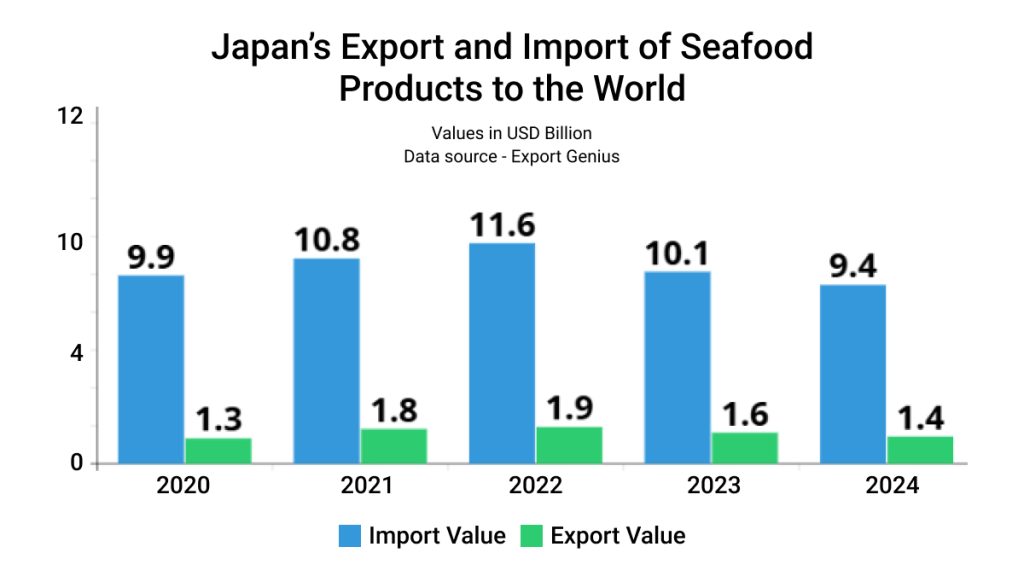
| Japan Seafood Trade from 2020 -2024 | Japan Seafood Import Value (Billion) | Japan Seafood Export Value (Billion) |
| 2020 | 9.9 | 1.3 |
| 2021 | 10.8 | 1.8 |
| 2022 | 11.6 | 1.9 |
| 2023 | 10.1 | 1.6 |
| 2024 | 9.4 | 1.4 |
Japan’s Top Export Destination for Seafood
Japan’s overall seafood export has drastically declined by 26.3% since 2022. However, supplies to the top destination increased during the period, showing strong demand and market potential. Let’s understand this with some stats –
- The US is Japan’s largest trading partner for seafood products, exporting more than 25% of the total supplied value. For instance, US seafood imports from Japan stood at $370 million in 2024.
- In 2024, Japan’s exports to Vietnam, Thailand, and South Korea increased by $50, $27, and $21 million, respectively, compared to the previous year.
- Notably, exports to Taiwan decreased by $17 million in the last three years, indicating weak demand or emerging suppliers.
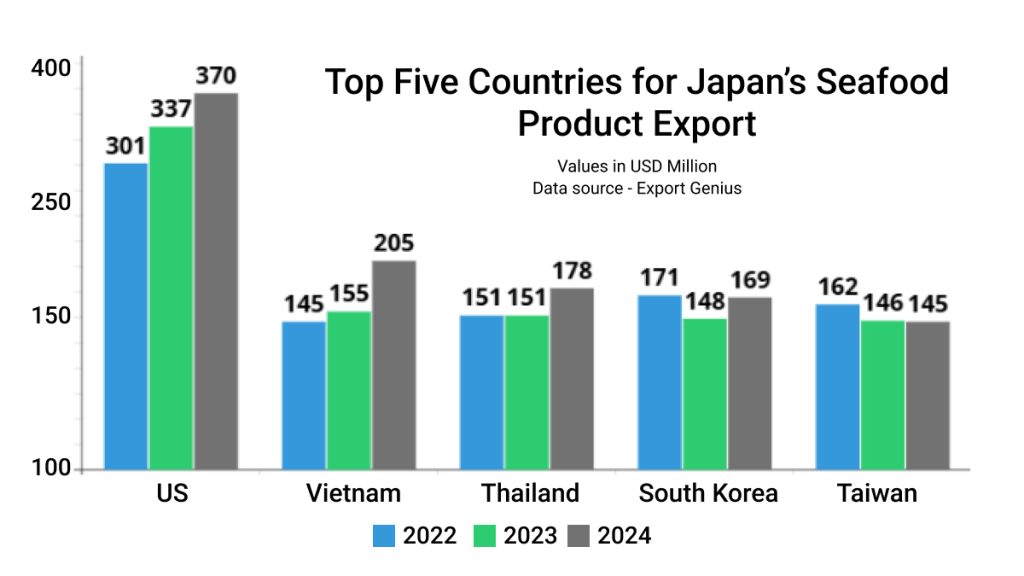
| Japan’s Seafood Exports to the Top Countries | Exports in 2022 | Exports in 2023 | Exports in 2024 |
| US | 301 | 337 | 370 |
| Vietnam | 145 | 155 | 205 |
| Thailand | 151 | 151 | 178 |
| South Korea | 171 | 148 | 169 |
| Taiwan | 162 | 146 | 145 |
Japan’s Top Five Seafood Import Partners
For a long time, fish and cuisine have been a crucial part of the Japanese food culture, and their daily diet. This makes the country dependent on imports globally due to a lack of supply from the domestic market, and a declining pattern due to ocean warming and climate change. Here’s the import value –
- Chile and China are the most important sources of Japan’s seafood, and in 2024, they exported $1.2 billion and $1.07 billion, respectively.
- Japan’s seafood imports increased to Chile and China in 2024. But the import value has drastically declined with all the top partners in 2024, compared to 2022.
- The decline in import value highlights the potential disruption to seafood and seaweed farming caused by ocean warming and climate change.
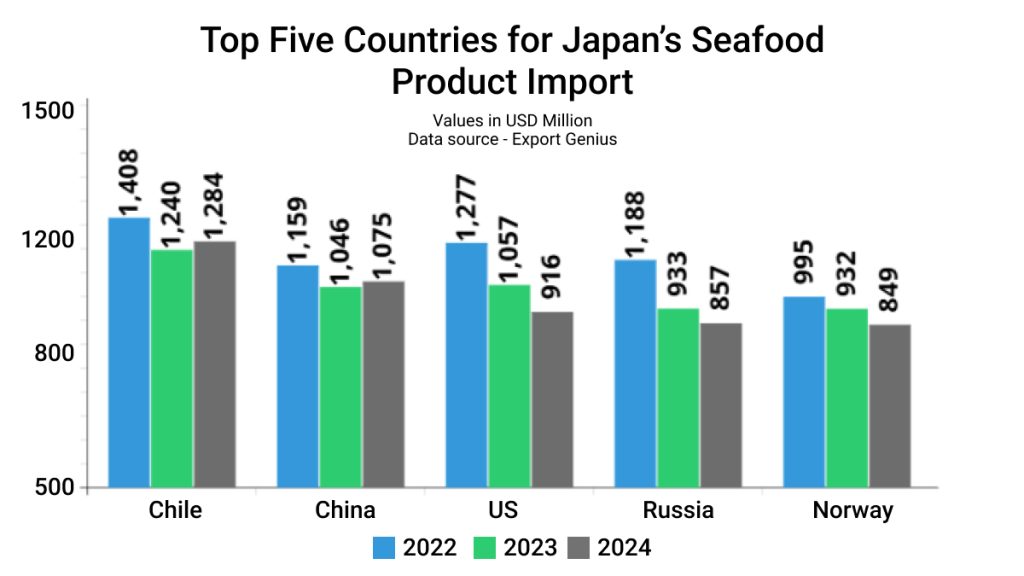
| Top Origin Countries For Japanese Seafood Imports | Imports in 2022 | Imports in 2023 | Imports in 2024 |
| Chile | 1408 | 1240 | 1284 |
| China | 1159 | 1046 | 1075 |
| US | 1277 | 1057 | 916 |
| Russia | 1188 | 933 | 857 |
| Norway | 995 | 932 | 849 |
Climate Change & Seafood: Worldwide Effect
As the ocean temperature and climate change threats are rising, marine habitats are at great risk. For instance, a shift in fish population from warm to cold oceans will result in disruption in the entire marine food web, leading to global seafood supply vulnerability. Here’s a glimpse –
- Change in Fish Habitats – Due to warming waters, fish and other ocean species are forced to migrate from warm oceans to cooler regions. This affects traditional fishing grounds and creates geological tensions over shared resources. For instance, China claims traditional fishing grounds in the South China Sea.
- Habitats Degradation – Increased ocean temperature and acidification severely threaten the coral reefs and other vital marine habitats. This impacts fish breeding and nursery grounds.
- Disrupted Food Webs – Plankton, a diverse group of microscopic organisms, is essential to the aquatic ecosystem, particularly for seafood and the marine food web. This affects the entire ecosystem, leading to reduced fish stocks.
Trade Data a Solution to Mitigate Challenges for Seafood Business
The challenges facing Japan’s seafood and seaweed industries present a critical situation for domestic suppliers and their market value. Here are the key ways through which trade data helps businesses –
- Identify High Potential Market – Spot the market where demand is rising for the specific product by identifying high demand market, trends, a business can expand with potential opportunities.
- Supply Chain Networks – Businesses can reduce risk and ensure a stable supply chain by assessing the capabilities and reliability of potential suppliers.
- Risk Mitigation – Eyeing on trade patterns and regulatory changes, businesses can identify potential risks, such as tariffs, trade barriers, or economic fluctuations, and take proactive measures to mitigate them.
- Strategic Planning – Trade data provides a historical record of market trends. For instance, Export Genius has provided export and import insights since 2010. This enables businesses to forecast future demand, anticipate market shifts, and develop effective long-term strategies.
Conclusion –
Rising ocean temperatures and climate change are putting seafood, seaweed farming, and the aquatic ecosystem at great risk. This also affects the entire seafood web, causing a lack of food availability and disruption in the supply chain. Hence, it becomes important not only for Japan but for all nations to adopt sustainable methods for seaweed farming and production to meet the rising demand. This also highlights the collective work needed to address climate change and ocean warming.